
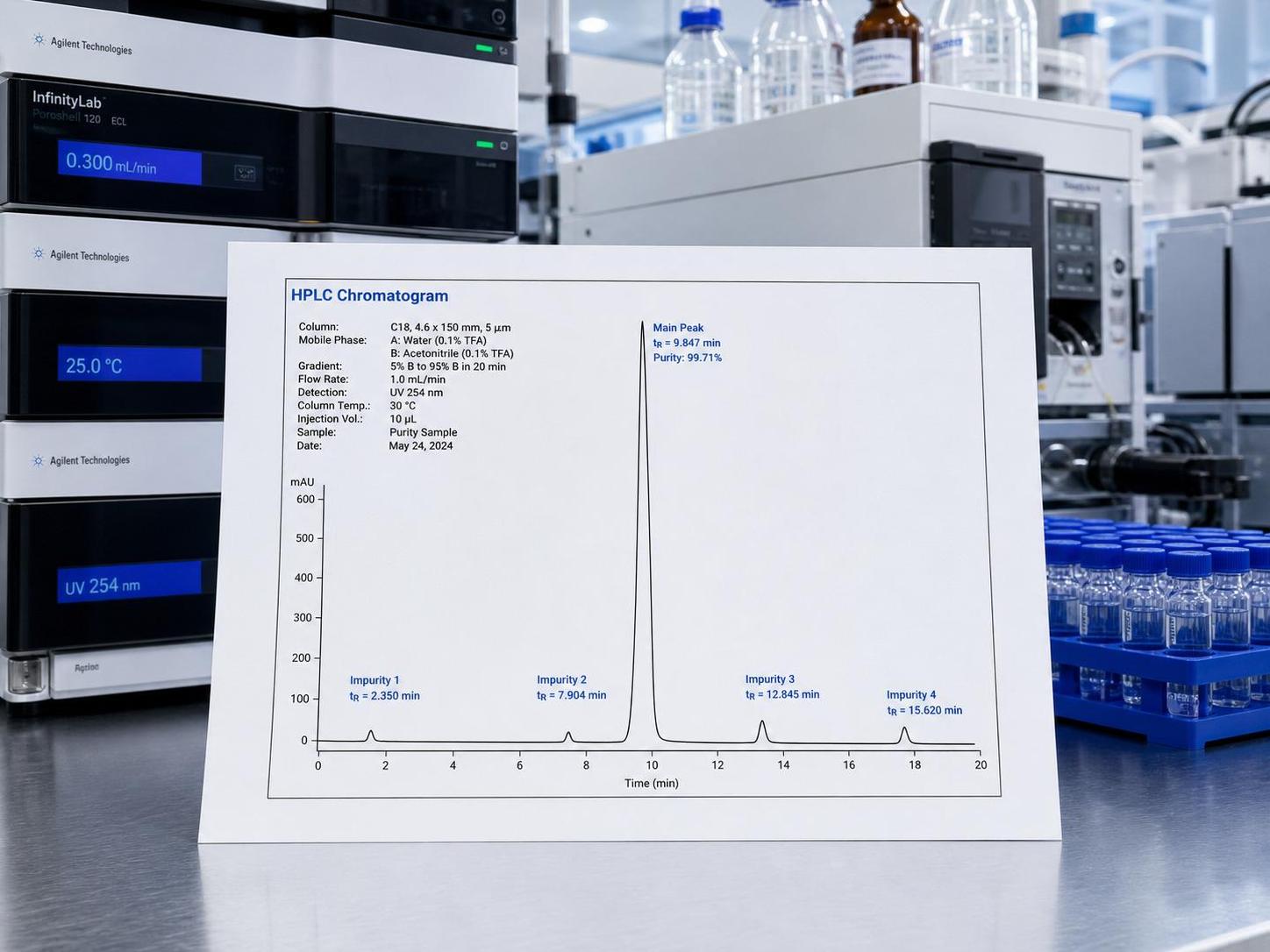
When sourcing custom peptides for research or industrial applications, the Certificate of Analysis (COA) is your primary document for quality verification. Within this report, the High-Performance Liquid Chromatography (HPLC) chromatogram stands as the gold standard for verifying the actual purity of the product. However, simply reading the percentage number on a report isn't enough. To ensure your custom peptide meets exact specifications, a professional buyer must know how to critically evaluate the raw chromatographic data.
Here is a technical guide on how to analyze an HPLC chromatogram to judge the true purity of your custom peptides.
1. Identify the Main Target Peak and Retention Time
The first step is to locate the primary, tallest peak on the chromatogram, which represents your target peptide. The position of this peak along the horizontal axis indicates its retention time ($R_t$). Under a specific mobile phase gradient and column temperature, a pure peptide should elute as a sharp, symmetrical peak.
If the main peak is heavily asymmetrical, skewed, or exhibits "tailing," it may indicate that the peptide is interacting poorly with the column stationary phase, or worse, that closely related structural isomers are co-eluting with your target molecule, masking the true impurity levels.
2. Check for Co-eluting Peaks and Fronting/Tailing
A flawless purity percentage on paper can sometimes obscure hidden impurities if the HPLC method parameters are not optimized. Examine the base of the main peak carefully.
Shoulders: A small hump or "shoulder" attached to the side of the main peak indicates a closely running impurity—such as a deletion sequence or a deamidated byproduct—that the column could not fully separate.
▪ Fronting: If the front slope of the peak is less steep than the back, it could indicate column overloading or the presence of faster-moving impurities.
▪ A truly high-purity custom peptide will show a distinct separation between the main peak baseline and any surrounding trace peaks.
3. Verify the Integration Baseline and Area Percentage
The purity value listed by the peptide factory is calculated using the Area Under the Curve (AUC) method. The software integrates the area of all detected peaks and calculates the target peak's percentage relative to the total area.
Look closely at how the baseline is drawn by the integration software. A dishonest or careless integration might artificially raise the purity percentage by drawing a baseline that cuts off smaller impurity peaks at the bottom, or by setting the detection threshold too high so that trace impurities are ignored. Ensure the baseline is flat, consistent, and includes all minor peaks from the injection start to the end of the run.
4. Cross-Reference the DAD/UV Detection Wavelength
Peptides are typically monitored using a Diode Array Detector (DAD) or UV detector at wavelengths around 214 nm or 220 nm, where the peptide amide bonds absorb light strongly.
Always check the top of the chromatogram to verify the wavelength used. If a factory runs the HPLC test at 254 nm or 280 nm (where only aromatic amino acids like Tryptophan or Tyrosine absorb), many impurities lacking these specific amino acids will become invisible to the detector. This results in an artificially inflated purity calculation. Ensuring the analysis was performed at 214–220 nm guarantees that all peptide-related impurities are accounted for.
Conclusion
An HPLC chromatogram is an un-fakeable fingerprint of your custom peptide's quality, provided you know how to read between the lines. By verifying peak symmetry, baseline integration accuracy, and correct detection wavelengths, B2B buyers can confidently audit their peptide factory’s data, ensuring complete transparency and uncompromised batch purity for their downstream projects.
Leave A Message
If you are interested in our products and want to know more details, please leave a message here, we will reply you as soon as we can.