
In the field of peptide manufacturing, lyophilization (freeze-drying) is the critical, defining step that determines the final quality, bioactivity, and long-term stability of the product. While often misunderstood as a simple "water removal" process, lyophilization actually presents high technical barriers when dealing with high-purity peptides.
To deliver premium products, elite peptide factories must overcome three major technical hurdles during the lyophilization process:
1. Precise Control of Eutectic Points and Collapse Temperatures for Complex Sequences
Every peptide possesses a unique amino acid sequence, hydrophobicity, and salt form, resulting in vastly different physical properties.
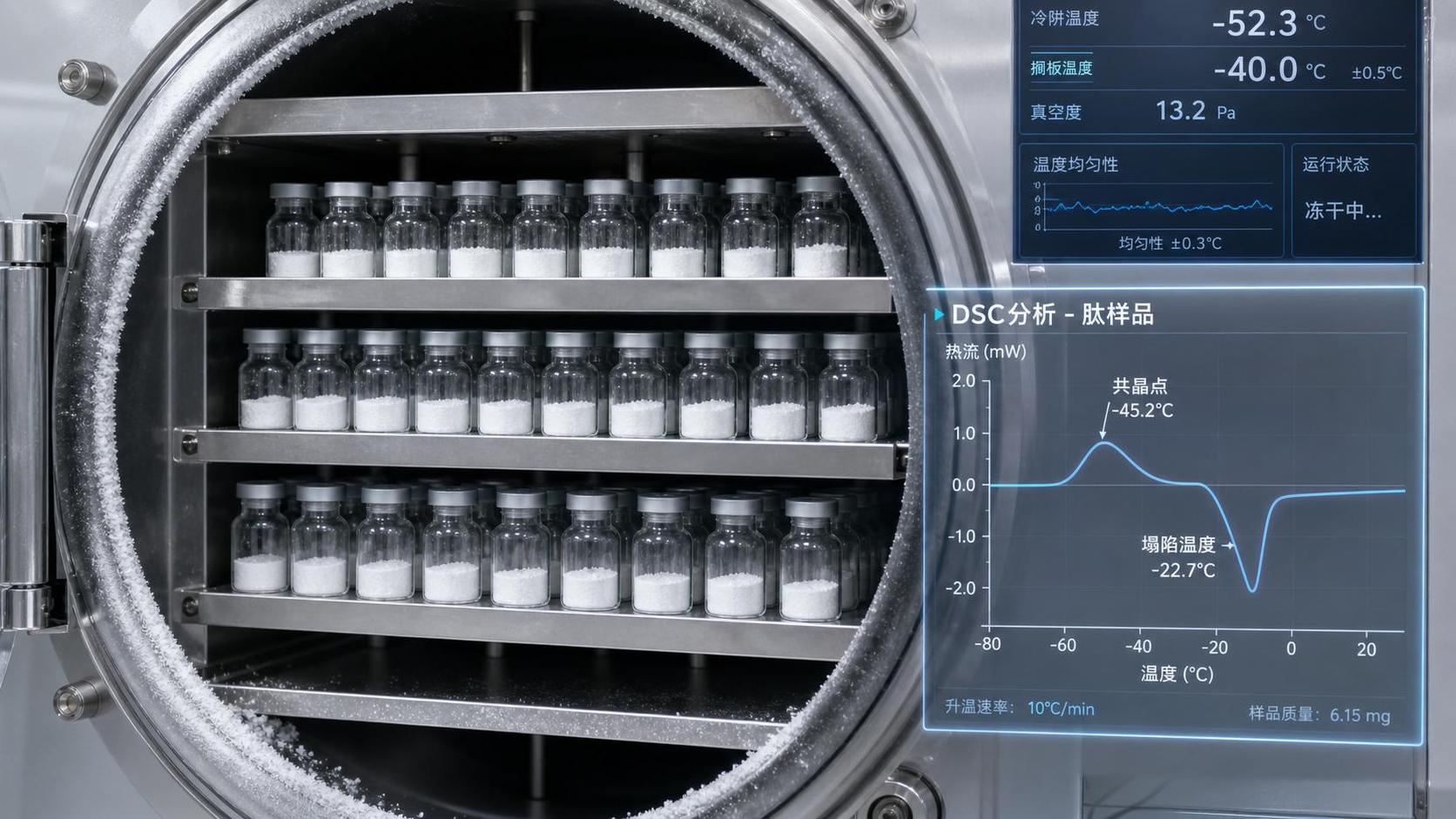
▪ The Core Technology: The two most critical parameters in freeze-drying are the Eutectic Point and the Collapse Temperature. If the temperature during the primary drying (sublimation) phase exceeds the collapse threshold, the peptide structure physically caves in—turning into a sticky gel or hard lump. This leads to poor solubility and a complete loss of bioactivity.
▪ The Barrier: Elite factories rely on advanced Differential Scanning Calorimetry (DSC) or freeze-drying microscopy to map out custom temperature curves tailored to each specific peptide sequence. This requires years of deep, empirical technical data.
2. Formulating Protectants to Prevent "Freeze Denaturation" and pH Shifts
As a peptide solution freezes and ice crystals form, solutes undergo recrystallization. This transition is frequently accompanied by drastic pH shifts and fluctuations in ionic strength within the microenvironment.
▪ The Risk of Degradation: These aggressive environmental changes can easily cause fragile peptides to undergo shearing, aggregation, or irreversible denaturation.
▪ The Barrier: Factories must possess sophisticated formulation expertise regarding protectants (excipients). By scientifically blending cryoprotectants like mannitol, trehalose, or specialized buffer systems, they create a "vitrified" protective matrix around the peptides, preserving their original 3D spatial structure and activity during dehydration.
3. Maintaining Uniformity During Industrial Scale-Up
Freeze-drying a few milligrams of a peptide in a small laboratory vial is relatively straightforward. However, scaling up to multi-kilogram industrial production inside a massive peptide factory causes the difficulty to increase exponentially.
▪ Shelf Temperature Uniformity: The temperature variation across the massive shelves of an industrial freeze-dryer must be strictly controlled (typically within $pm 0.5^circtext{C}$). Any uneven heat distribution results in batch inconsistency.
▪ Sterility and Vacuum Maintenance: Pharmaceutical and cosmetic-grade peptides require high-standard sterile environments throughout the cycle. Even a minor fluctuation in chamber vacuum pressure can directly compromise sublimation rates and product integrity.
Conclusion
Peptide lyophilization is far from just running a machine; it is a sophisticated science blending thermodynamics, biochemistry, and mechanical engineering. Only peptide factories that successfully overcome these lyophilization barriers can ensure that every batch delivered features a flawless, porous cake appearance, rapid solubility, and pristine biological activity.
Leave A Message
If you are interested in our products and want to know more details, please leave a message here, we will reply you as soon as we can.